
“Can you please wait a day or two for my share of work dinner expense from last night because I’ve spent all my pocket money…help me save my face or my wife will get mad!”
Colleagues
“I came back to work after a couple of days after my wife gave birth. She seemed to be handling it well so I didn’t feel the need to take any paternal leave.”
“7 years ago, my husband and I discussed that we have absolutely nothing in common. We just happen to live in the same place and I’m so excited that my husband’s going on a boys weekend to Taiwan.”
All these statements don’t paint a picture of rosy, loving family life, does it?
My New Zealander husband questioned me why his Japanese colleagues don’t seem happy to go home but rather choose business trips that extend into the weekend or stay out late for work drinks.
Without having any answers to his questions, I am surprised by the pace of Japanese relationship when I found out that a famous comedian, Yama-chan on the Netflix hit reality show, Terrace House married this June after dating an actress for a mere two months.
We theorized that maybe young Japanese people feel pressured to get married to start off with. They furiously go on arranged dating events called 合コン(Goukon), date a year or so and get married. However, perhaps the relationship is often ill-matched but they continue to stay in the marriage?
It may have been that our theory could have been quite pessimistic and completely wrong.
I was having a chat about this with my male director who is born and raised in Japan and for nearly a half a century that he’s been alive have only left the Japanese shores once.
“Ahh, I see what you mean but Japanese are worried about being seen as ”リア充“ (Ria-Jyu).
Japanese director
What is Ria-Jyu?
Shorten from “Real 充実 (jyujitsu, contentment)”, it’s when people actually have an awesome life. Often someone who is in a relationship, have many friends, enjoys hobbies, have a great relationship with family are considered as Ria-jyu.
Some people aspire to be ‘Ria-Jyu” but sometimes, people feel jealous of other’s Ria-Jyu. For the latter people, Japanese feel conscious about how they express their life. With culture to put yourself and your relations at a lower level to raise the person you’re talking to, Japanese often avoid expressing their “Ria-Jyu” life.

My director further explained how Japanese communicates in a triangular method.
Japanese triangular communication method
For example, you may be hungry and want to go out to eat a meal. Rather than saying “I’m hungry, let’s grab something to eat” to a friend (i.e. direct communication), the triangular communication method will be to say, “Have you heard about the cafe that’s opened up recently close by?”.
The friend will then contemplate why this information has been shared and deduce that the cafe was mentioned to suggest going there to eat now. The response will be, “No, I haven’t but shall we go and see what it’s like?”
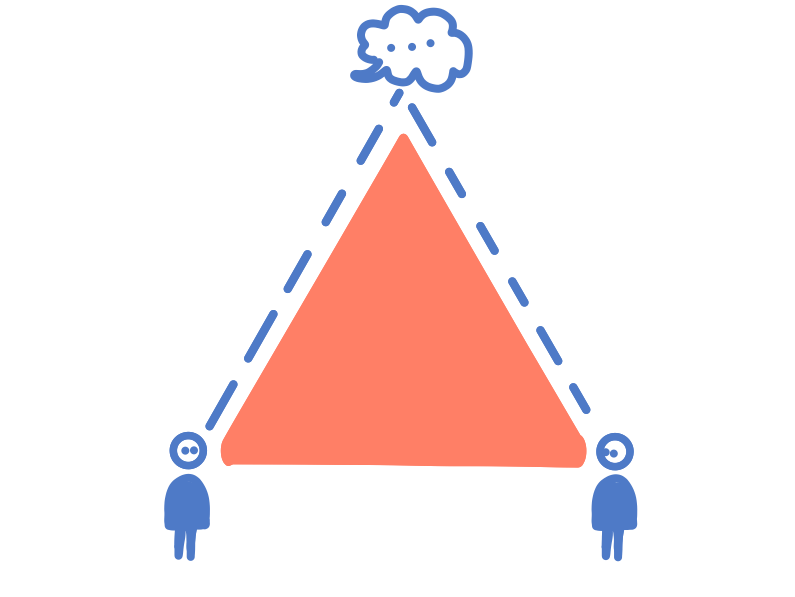
As you can imagine, this can backfire where the friend may misinterpret the statement with something like, “maybe she wants to show off that she knows a lot of trendy new places to go, I’ll ask what the place is like.”
With the lense of “avoiding being seen as ria-Jyu” and the Japanese triangle communication method, the first few sentences from this post perhaps aren’t what it literally sounds like:
“Can you please wait a day or two for my share of work dinner last night because I’ve spent all my pocket money…help me save my face or my wife will get mad!”
AKA: My wife is really good with our finance whom I totally rely on.”
“I came back to work after a couple of days after my wife gave birth. She seemed to be handling it well so I didn’t feel the need to take paternal leave.”
AKA: My wife is rock solid superstar and I’m really proud of her and our healthy and well-behaved baby.
“7 years ago, my husband and I discussed that we have nothing in common. We just happen to live in the same place and I’m so excited that my husband’s going on a boys weekend to Taiwan.”
AKA: “We respect each other’s boundaries and independence. I’m not clinging onto my husband but trust him completely when he goes on a holiday with his friends overseas while I relax at home enjoying my personal time.”
The moral of the story is: don’t take what a Japanese person say literally.
 Native Expat